
 June 15, 2026 - BY Admin
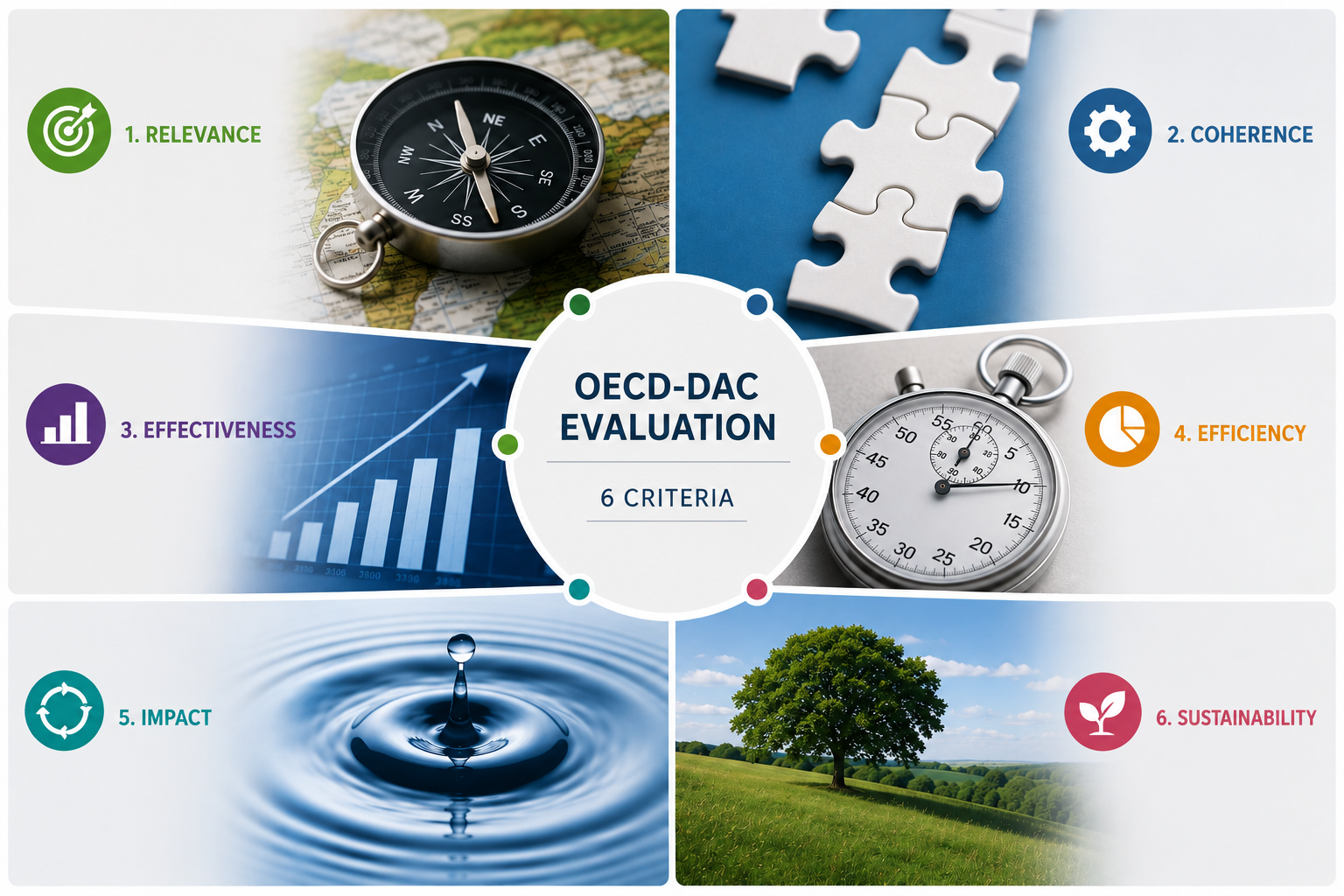
If you work in MEAL, you've almost certainly been handed a terms of reference that asks you to assess a project against the OECD-DAC criteria: relevance, coherence, effectiveness, efficiency, impact, sustainability , and you've almost certainly never been formally taught what any of them actually mean. They sit in the ToR like a checklist you're expected to already understand. So you do your best, you organise the report under six headings, and you hope the structure does the talking.
Here's what we've learned from sitting on both sides of these evaluations: the six criteria aren't really headings. They're questions a donor is asking quietly in the background, and each one has a subtext that matters more than the label on top of it. Once you can hear the question behind the question, the whole framework stops feeling like a compliance exercise and starts working for you.
This is the version we wish someone had given us early on.
A quick note on "six," not "five"
If you trained on this framework more than a few years ago, you learned five criteria. In 2019 the DAC revised them, and coherence was added as the sixth. It's the one most teams still fumble partly because it's newest, partly because it's the least intuitive. A report that quietly ignores coherence reads as dated to anyone paying attention.
Relevance"Was this the right thing to do?"
On the surface, relevance asks whether the project responded to a real need. Easy enough to assert. The catch is that donors aren't only asking whether the need existed at design; they're asking whether you understood it, and whether your understanding held up as the context shifted.
Did you design for the population, or did you design for the proposal? In humanitarian settings especially, needs move. A project that was relevant at approval can be quietly irrelevant eighteen months later, and an honest relevance section says so. Evaluators who only ever write "the project remained highly relevant" tend to lose credibility on everything that follows.
Coherence"Did it fit with everything else going on?"
This is the new one, and it's two questions wearing one coat. Internal coherence asks whether the intervention fit with the organisation's own other work and policies. External coherence asks whether it fit with what everyone else - other agencies, government systems, other donors was doing in the same space.
Did this project duplicate, contradict, or undercut something else? Did it plug into national systems or build a parallel one that collapses the day funding ends? Coherence is where donors look for evidence that you understood you weren't operating alone. A strong coherence section names the other actors specifically and is honest about the friction, not just the partnerships that worked.
Effectiveness"Did it achieve its objectives?"
The most familiar criterion, and the one most likely to be answered with a wall of indicator numbers. Targets met, targets missed, percentages against the logframe.
Not whether you hit the targets, but whether you understand why. A donor can read an IPTT themselves. What they're paying an evaluator for is the causal story, which activities actually drove the result, which assumptions held, and which "successes" were really just favourable conditions you happened to operate in. Effectiveness done well explains the mechanism, not just the score.
Efficiency"Was it worth what it cost?"
Efficiency covers both money and time: were resources converted into results economically, and did things happen when they were supposed to?
Increasingly, value for money and donors are more cost-conscious now than they were five years ago. This is the criterion teams most often dodge, usually because the financial data is messy or arrived late. But a donor reading a vague efficiency section assumes the worst. You don't need a full cost-effectiveness analysis to do this well; you need to actually engage with cost per outcome, with delays and what they cost, and with the trade-offs the project made under pressure. Honesty about a delay reads far better than silence about it.
Impact"Did it actually matter?"
Impact asks about the higher-order, longer-term change; the difference the project made beyond its immediate outputs.
Two things teams routinely skip. First, attribution versus contribution, are you claiming the project caused the change, and can you defend that, or is the honest framing that it contributed alongside other forces? Overclaiming here is the fastest way to lose a sophisticated reader.
Second, unintended effects, including negative ones. An impact section that only reports good news that nobody planned for is not a serious impact section. Donors trust evaluators who surface the uncomfortable findings, because it tells them the positive findings were scrutinised just as hard.
Sustainability"Will any of this last?"
Sustainability asks what continues once the funding stops; the benefits, the capacities, the systems.
The honest answer, not the hopeful one. Almost every project writes itself a sustainability plan; far fewer can show that the plan was real. Donors are reading for evidence of handed-over assets that are actually being used, local ownership that existed before the closing workshop, financing that doesn't depend on a follow-on grant. If sustainability is genuinely fragile, saying so plainly (and explaining what would be needed to secure it) is more useful to a donor than an optimistic paragraph everyone knows to discount.
The criteria are a conversation, not a checklist
Read together, the six criteria are really one extended question a donor is asking: did this project understand its context, fit into it, work, justify its cost, change something real, and leave something behind? When you organise a report mechanically, six sections, findings dropped under each, you answer the labels but miss the conversation. When you write to the subtext, the same evidence does far more work, and the report reads like it was written by someone who has actually run an evaluation rather than someone formatting one.
That distinction is most of what separates a report that satisfies a ToR from one that a donor remembers.
Planning an endline or final evaluation?
At M & E Lab Consultancy Limited, designing and leading OECD-DAC evaluations is core to what we do across humanitarian health, WASH, protection, and livelihoods programming in the region. If you want an evaluation that reads as credible to the people funding it, let's talk.
Message us on WhatsApp